PFC Harry P. Anderson
– H Company, 2nd Battalion, 47th Infantry Regiment –

Harry P. Anderson was born on March 8, 1925 at Renovo, PA to Harry A and Elsa Marie Anderson. He was the first of three children, having two sisters, Florence and Joyce. He grew up in a company house owned by the Pennsylvania Department of Forest and Waters at a place called Cooks Run. His dad was a Forest Ranger in the Sproul State Forest. As a boy and teenager being brought up in the woods he enjoyed hunting and fishing with his dad. This is very evident by his letters home from the Army. In the spring of 1944 he would write “Dad, I’ll bet the fish are really biting. Did you catch your limit? Wish I was there to go with you.” In the fall he would write the same things about hunting. From the letters he wrote you could tell that he was great pals with his Dad and considered his Mom as the best Mom in the world. He would always be very thankful to his Mom for the packages she sent with socks, sweaters, cookies, cigarettes and a pipe. He also received many packages with goodies from his Aunt Bart and Aunt Esther.
With World War II well under way Harry joined the Army shortly after his 18th birthday. He was inducted at New Cumberland, PA on June 30, 1943. He was then sent to Camp Wheeler, GA for several months for basic training. He was then transferred to Fort George G. Meade in Maryland for a short stay of a couple weeks. While there it is believed that he was able to take a short leave and return home for a short visit. He did get a visit home around this time so we assume it would be when he was this close.
In early December of 1943 his location became classified and his letters began to say only “Somewhere in New England”. In a journal that he started he indicates this was at Camp Myles Standish in Massachusetts. The journal also states that they left Standish on December 28th, 1943 and went to Boston for a day, then embarked on a ship on the 29th and set sail for England. He said he got a little seasick after 4 days but it subsided and got better. On the 11th day at sea they arrived at Liverpool, England. From there they marched 1⁄2 mile to the train station where they boarded a train for an all night ride to a replacement camp near the town of Yeovil. They stayed there for 2 weeks and then were shipped to the 9th Infantry Division and placed in a rifle company. He was in the rifle company for about one week and was then transferred to heavy weapons.
January 26, 1944 is his first letter with the return address of Company H, 47th Infantry APO #9. This remained his address throughout the remainder of his service. He arrived at Company H on February 1st 1944. He had training every day after that, sleeping in their pup tents and eating rations as if on the battlefield. During one 7 day exercise he received 2 packages from home. He stated “They certainly are swell parents, the best in the world. The cookies and candy were very handy at the time because I was hungry.” At one point he could see and hear bombing off in the distance and once witnessed a dogfight in view of their camp. He said he could see the tracers from the guns on the planes. He said he didn’t have a very happy 19th birthday since he had guard duty. Training in England continued through June 9th, 1944.
On June 10, 1944, D-Day+4, they crossed the English Channel and landed at Utah Beach in Normandy, France. Their first contact with the occupying Germans was on June 14, 1944. His first letter home was also written on June 14th, from France. According to the history on the 47th Infantry Regiment they were ordered to clear the Cherbourg / Cotentin Peninsula of Germans. In late June of 1944 Harry’s parents received word that Harry was awarded the Bronze Star. The citation to his parents reported that he
“distinguished himself by heroic achievement in action against the enemy June 22, 1944 in the vicinity of Cherbourg, France. During a fierce fight with the enemy, PFC Anderson saw a German throw a hand grenade among the members of his squad. With complete disregard for personal safety, he exposed himself to direct enemy observation fire to locate the enemy’s exact position. Anderson then returned to a machine gun position and fired on the enemy, killing him before he could throw any more grenades“.
On June 30, 1944 at about noon, Harry was wounded while they were taking a small town. On this date, 2nd Battalion was half a mile south of the town of Acqueville. At 08:00 in the morning, Company H supported an attack of Gréville-Hague. The objective was taken at 10:00. The 2nd Platoon attached to F Company for extra fire power was subjected to heavy enemy mortar fire and suffered heavy casualties. The Company moved forward with the Battalion and occupied positions in the vicinity of Acqueville. On this rainy day, 2 enlisted men were killed in action, and 1 officer and 14 enlisted men were wounded, including PFC Anderson.
In a letter home he said that he was wounded in three places; twice in his left leg and once above his right eye. He describes a little of how this happened in a letter that he wrote to his Dad. He wrote that a tank had pulled up close to their position and apparently drew mortar fire from the Germans He was hit with shrapnel from this fire. The Command Post was located at Vasteville (2 miles south west of Acqueville) Manche, France at this time. He was sent to a hospital in England where he spent over three months. His outfit received a Presidential Unit Citation for their action at Cherbourg.
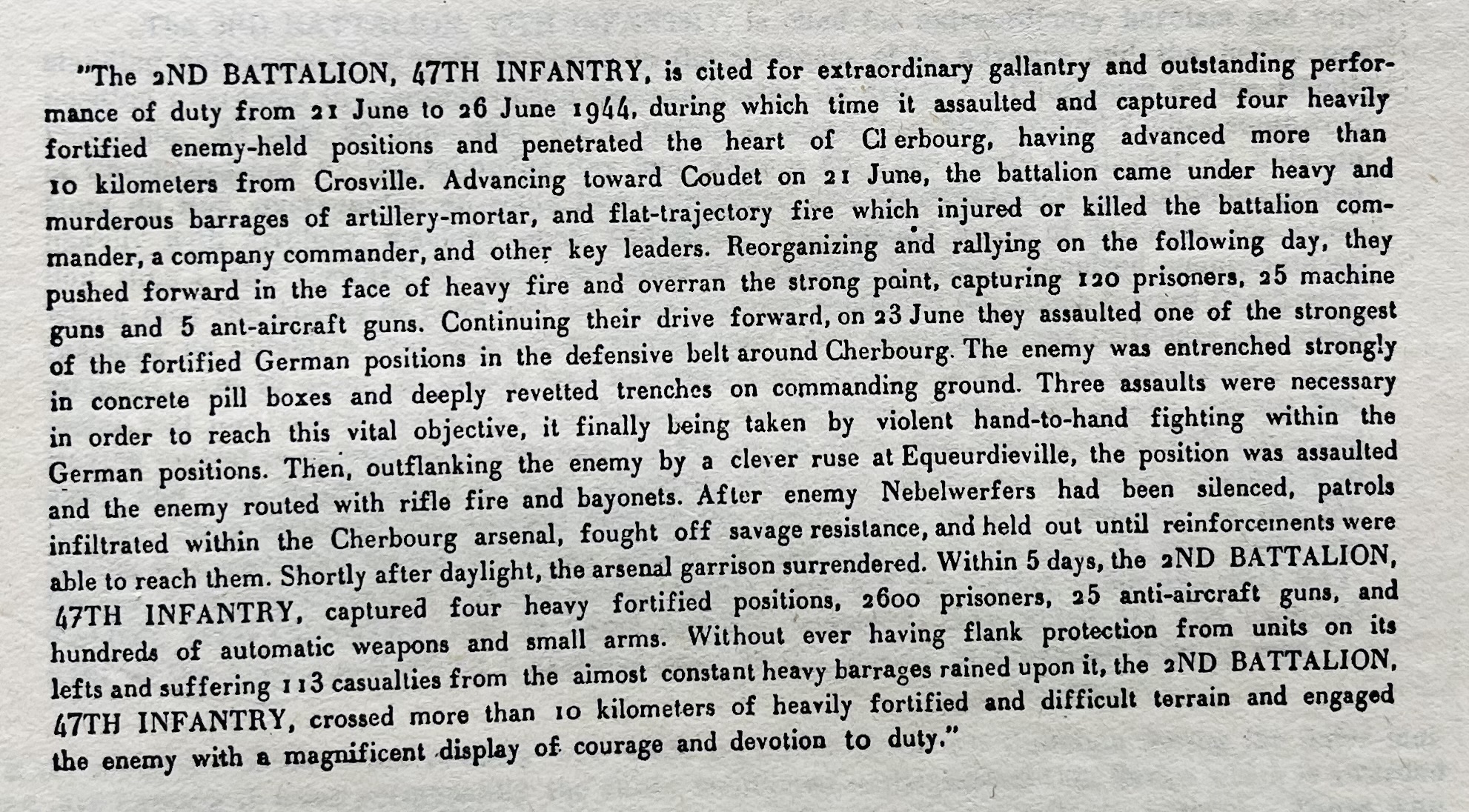
Back in France by September 1944 he had to catch up with his unit, which was in Belgium by this time. He finally caught up with them near Nideggen, Germany about October 22nd. This was in the middle of a series of battles fought in the Hurtgen Forest, Germany. On November 25th he wrote home that he was wounded, a graze under his left eye. This wound was treated in the field and Harry was returned to service. He received his 2nd Purple Heart. There was not much forward progress made that winter of 44-45. During this time the Battle of the Bulge took place.
Some of the fiercest fighting of the European theater took place during that winter. Harry was part of it, one of many, as a gunner in a machine gun squad of five men. We have the names of two of those men and have been in contact with the son of one of them.
Squad Leader: Tech Sgt Clifton Goodgame
Squad Member: James R. Surles
With the spring came forward advancement across the border into Germany for the 9th Infantry Division.
One of the main objectives was to get across the Rhine River. They marched and fought their way toward the Ludendorff Bridge at Remagen.
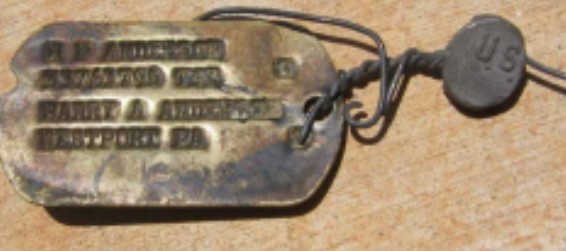
Harry never made it to the Rhine. While the Command Post was located at Muddersheim Rhineland, Germany Harry was killed in action less than 7 miles (11km) from the Command Post. His Silver Star Citation reads, in part;
“Private First Class Anderson distinguished himself by gallantry in action against the enemy on 4 March 1945, in the vicinity of Fraunenberg, Germany. While supporting the assault elements of the Infantry, Private First Class Anderson’s machine gun position was subjected to intense enemy fire. Displaying aggressive
initiative and complete disregard for his personal safety, he directed a heavy volume of effective fire on the withdrawing enemy, inflicting numerous casualties. Despite the concentrated small arms fire directed at his position, Private First Class Anderson remained at his post and continued to render supporting fire for the assaulting infantry until killed. Private First Class Anderson’s devotion to duty and courageous actions contributed to the success of the unit’s operation and were, at all times, a credit to himself and to the Armed Forces of the United States.”
His Bronze Star Citation, in part: “Private First Class Anderson distinguished himself by heroic achievement in action against the enemy on 22 June 1944 during operations in ****.” This then classified location would be just South of Cherbourg, France.
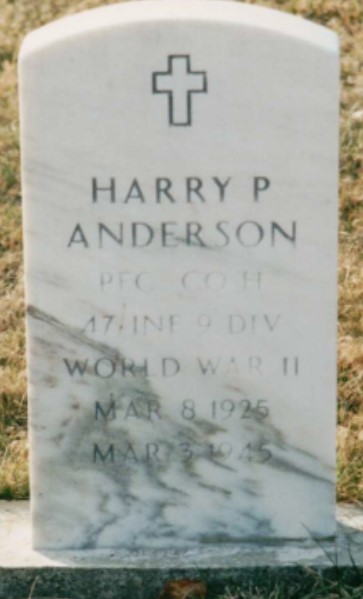
Harry’s body was temporarily buried in the United States Military Cemetery Henri-Chapelle, Belgium. His body was later exhumed and sent home, arriving in Renovo, PA at 3:36 PM on November 19, 1947 on Pennsylvania Railroad train number 571. Funeral services were held the very next day with Reverend George Hopkins, Pastor of Gospel Tabernacle conducting the service. He is buried at the North Bend Cemetery just east of Renovo, PA.
We will never forget the actions of Harry, that resulted in the freedom we enjoy today.
Special thanks to Harry Shearer, who wrote this beautiful tribute to his Uncle.
 9th Infantry Division in WWII